
The Bottom Line First:
- A Historic Shift in Leadership: For the first time in over 60 years, the Q1 2026 13F filing (released May 15, 2026) does not bear Warren Buffett’s name as CEO. Greg Abel officially took the reins on January 1, 2026, ushering in an era of aggressive portfolio consolidation.
- The Unprecedented Cash Pile: Berkshire is now sitting on a staggering record cash reserve of approximately $397 billion, signaling extreme caution regarding current market valuations.
- Major Exits and AI Bets: In Q1 2026, Berkshire fully exited 16 positions, dumping blue-chip giants like Visa and Amazon. Conversely, Abel flexed his muscles by tripling the fund’s stake in Alphabet (GOOGL) to secure a footprint in the AI supercycle.
When the latest 13F regulatory filing dropped on May 15, 2026, Wall Street witnessed a seismic shift in modern financial history. For the first time in over six decades, the Berkshire Hathaway portfolio was not actively managed by Warren Buffett. Following his official resignation as CEO on January 1, 2026, his successor, Greg Abel, is now executing the playbook.
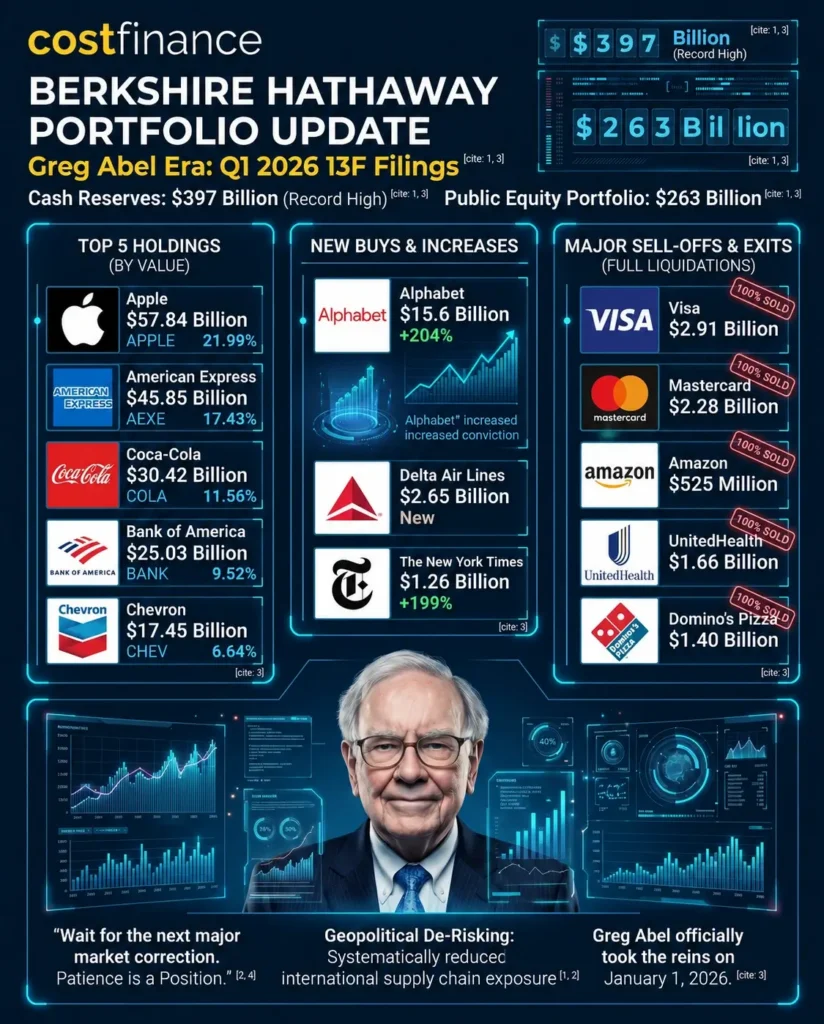
Abel’s first quarter in charge was anything but quiet. The latest filing reveals an aggressive cleanup operation: shrinking the equity portfolio down to just 26 stocks, hoarding almost $400 billion in cash, and making highly concentrated, multi-billion-dollar pivots.
Here is the exact breakdown of Berkshire Hathaway’s public equity portfolio, complete with dollar values, new acquisitions, and the major sell-offs that have the market on edge.
The Top 5 Core Holdings: The Financial Breakdown
Despite the change in leadership, the foundation of Berkshire’s $263 billion public equity portfolio remains heavily anchored in Buffett’s legacy. However, the exact capital distribution reveals a highly concentrated bet on unassailable monopolies.
As of the Q1 2026 filing, here is where the largest pools of capital are deployed:
- Apple (AAPL) — 21.99% of Portfolio
- Investment Value: $57.84 Billion
- Insight: Despite trimming over the past year, Apple remains the undisputed anchor of Berkshire. The firm treats the iPhone ecosystem as a consumer staple rather than a volatile tech asset.
- American Express (AXP) — 17.43% of Portfolio
- Investment Value: $45.85 Billion
- Insight: A legacy financial moat that continues to thrive on high-net-worth consumer spending and bulletproof brand loyalty.
- Coca-Cola (KO) — 11.56% of Portfolio
- Investment Value: $30.42 Billion
- Insight: The ultimate inflation hedge. Coca-Cola’s pricing power allows it to generate massive, reliable dividends regardless of macroeconomic turbulence.
- Bank of America (BAC) — 9.52% of Portfolio
- Investment Value: $25.03 Billion
- Insight: Berkshire remains deeply committed to traditional U.S. banking infrastructure, utilizing BAC as a bet on the resilience of the American economy.
- Chevron (CVX) — 6.64% of Portfolio
- Investment Value: $17.45 Billion
- Insight: While Berkshire reduced this position by roughly 35% in Q1 2026, Chevron remains a critical cash-generating asset amidst rising geopolitical energy risks.
What Berkshire BOUGHT in Q1 2026 (Jan – Mar 2026)
Greg Abel is proving he is willing to swing big, particularly in areas Buffett historically avoided. The Q1 2026 purchases highlight a pivot toward AI infrastructure and deep-value cyclical plays.
- Alphabet / Google (GOOGL & GOOG): In a massive display of conviction, Berkshire increased its stake in Alphabet Class A shares by a staggering 204%, buying roughly 40 million new shares. The total position is now worth $15.6 Billion, pushing it into the fund’s top tier. This is a direct bet on Google Cloud and its AI capabilities.
- Delta Air Lines (DAL): Reversing Buffett’s pandemic-era exit from the airline industry, Abel opened a massive new position in Delta, buying 39.8 million shares valued at $2.65 Billion.
- The New York Times (NYT): Berkshire nearly tripled its position (+199%) to roughly $1.26 Billion, signaling confidence in the publisher’s digital subscription moat.
What Berkshire DUMPED in Q1 2026 (Jan – Mar 2026)
The most aggressive move in the May 2026 update wasn’t the buying; it was the selling. Berkshire executed a brutal cleanup, entirely exiting 16 different stocks to the tune of $8.1 billion in net sales. This indicates that the firm believes the margin of safety on these assets has completely eroded.
Major Full Exits (100% Sold):
- Visa (V): Completely liquidated a position worth roughly $2.91 Billion.
- Mastercard (MA): Completely liquidated a position worth roughly $2.28 Billion.
- UnitedHealth (UNH): Completely liquidated a position worth roughly $1.66 Billion.
- Domino’s Pizza (DPZ): Completely liquidated a position worth roughly $1.40 Billion.
- Amazon (AMZN): Completely liquidated a position worth roughly $525 Million.
Note: Berkshire also drastically slashed its existing holding in Constellation Brands (STZ) by 95%.
The CostFinance Verdict
The May 2026 13F filing is a wake-up call for retail investors. The fact that Greg Abel chose to liquidate elite global companies like Visa, Mastercard, and Amazon while amassing a historic $397 billion cash reserve speaks volumes.
Berkshire Hathaway is not preparing for a bull run; they are fortifying their defenses. By concentrating capital into a smaller pool of 26 high-conviction stocks and rotating heavily into Alphabet for AI exposure and Delta for deep-value cyclical recovery, the firm is preparing for a macroeconomic storm. For the everyday investor, the strategy is clear: trim your overvalued winners, do not fear holding cash, and only deploy capital when the market offers an undeniable discount.