
TL;DR: The Urgent Reality
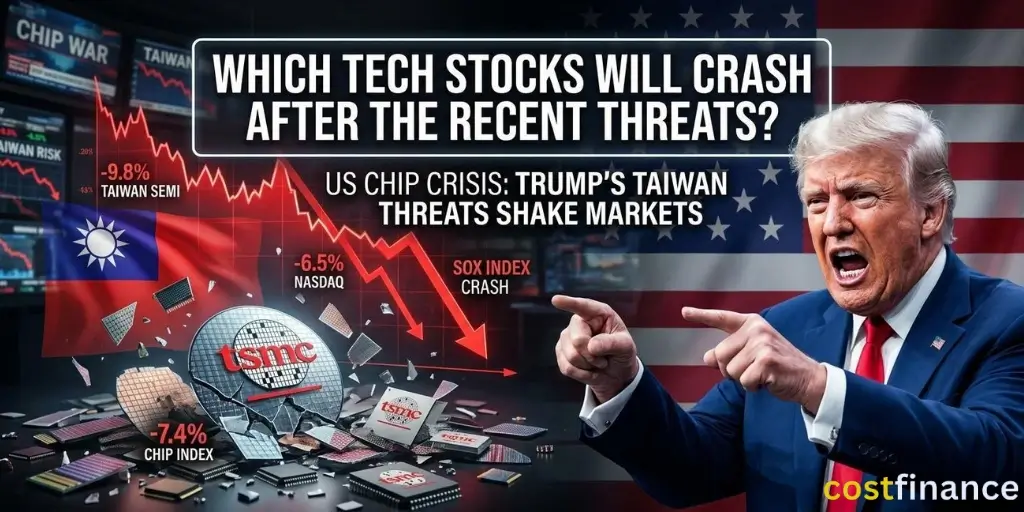
- The Fresh Catalyst: Following yesterday’s aggressive military posturing by Beijing and Washington’s blunt warnings regarding Taiwan’s “protection fees,” Wall Street is pricing in a much faster conflict timeline.
- The Immediate Victims: Mega-caps like Apple and NVIDIA are sitting in the direct line of fire due to their 100% reliance on Taiwanese manufacturing.
- The Capital Safe Havens: Smart money is aggressively rotating out of Asia-dependent tech and into domestic foundries (Intel) and military space infrastructure (RKLB, ASTS).
Geopolitical risk is no longer a “someday” problem for your portfolio. It is happening right now.
Following yesterday’s sharp escalation—where Beijing intensified its military surrounding the strait and Washington reignited anxieties by demanding Taiwan pay heavier “protection fees” for US military backing—the financial clock has officially sped up. Wall Street is no longer asking if a blockade will happen; they are actively preparing for when.
If you hold modern tech stocks, you need to understand exactly why this fresh tension makes your portfolio incredibly vulnerable, and where the smart money is moving today.
Why Yesterday’s Escalation Changes Everything for Investors
For months, the market treated the Taiwan situation as background noise. That changed yesterday.
The latest round of rhetoric has made one thing clear: Taiwan is caught in a vice between China’s aggressive reunification timeline and a shifting US foreign policy that treats geopolitical defense as a transactional business. When Washington openly pressures Taiwan about bearing its own military costs, it sends a wave of panic through institutional boards.
Wall Street analysts are quietly realizing that the old status quo is gone. If the US hesitates or if China detects a window of vulnerability, a sudden naval blockade becomes highly probable. Because Taiwan produces over 60% of global semiconductors and 90% of advanced processing chips, even a brief 72-hour blockade would instantly choke the global supply chain.
Billionaires Are Already Cutting Exposure
You do not have to guess how the world’s sharpest financial minds are reacting to this week’s news. They have been quietly de-risking for months, and yesterday’s events just validated their caution.
Warren Buffett famously dumped 86% of Berkshire Hathaway’s multi-billion-dollar stake in TSMC (Taiwan Semiconductor Manufacturing Company) shortly after acquiring it, stating bluntly, “I don’t like its location.” Buffett openly recognized that no matter how profitable a company is, you cannot outrun geography when superpowers clash.
Similarly, billionaire Ray Dalio has consistently warned that the economic war between the US and China over the Taiwan Strait is approaching a dangerous “red line.” When the individuals who built their wealth on calculated risk start moving billions out of the region, retail investors cannot afford to remain complacent.
The Burning NASDAQ: Who Crashes First?
If a conflict breaks out tomorrow, the NASDAQ will experience a historic, violent split.
The Direct Casualties: Apple and NVIDIA
The mega-caps that powered the market’s recent bull runs are the exact companies most exposed to this geopolitical chokepoint. NVIDIA builds the world’s most advanced AI GPUs, but they cannot manufacture a single one without TSMC’s specialized foundries.
Apple is in the same boat; their entire hardware ecosystem relies on chips stamped out on Taiwanese soil. Analysts estimate that if Taiwan’s shipping lanes are frozen, these tech giants will face immediate production halts, leading to wiped-out earnings and a massive panic sell-off within hours.
The Capital Rotation: Where Wall Street is Hiding Cash
Money never completely vanishes from the market during a crisis; it simply rotates. Institutional funds fleeing Asia-dependent tech will immediately flood into companies that provide domestic security and independent infrastructure.
1. Onshore Semiconductors
Intel (INTC) and GlobalFoundries (GFS) become instant targets for institutional buyers. While they currently lag behind TSMC in terms of absolute processing speed, they possess physical manufacturing plants on secure US and European soil. In a supply chain war, physical proximity and national security matter infinitely more than a slightly faster microchip.
2. Space-Based Infrastructure and Security
When terrestrial borders become volatile, nations secure the ultimate high ground: space. Defense analysts have repeatedly pointed out that in a modern Pacific conflict, cutting-edge satellite communication is the backbone of survival.
Aerospace and satellite technology companies—such as Rocket Lab (RKLB), AST SpaceMobile (ASTS), and Sidus Space (SIDU)—are positioned to see massive inflows of government and military funding. These stocks represent a high-growth, tactical hedge because their core infrastructure sits entirely outside the reach of naval blockades or regional land wars.
The CostFinance Strategy
Yesterday’s headlines were a wake-up call. As a CostFinance reader, your immediate move shouldn’t be to panic-sell your entire portfolio, but to rigorously audit your tech holdings.
Look at your exposure to companies reliant on East Asian manufacturing. Rebalancing a portion of those funds into domestic chipmakers and advanced space defense stocks ensures that when the mainstream media finally starts printing front-page articles about a full-blown supply chain collapse, your capital will already be anchored safely on the winning side of the macro trade.