
The Bottom Line First
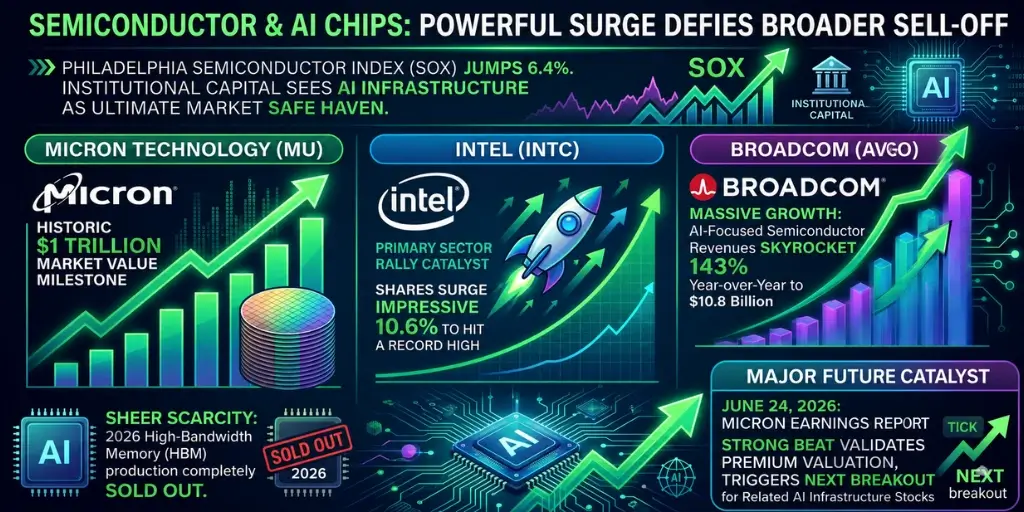
- The Sector Rally: While broader U.S. markets faced mixed sentiment, equities saw a powerful rally driven by semiconductor stocks. The Philadelphia Semiconductor Index soared 6.4%, reflecting deep confidence in long-term AI and data-center infrastructure demand.
- Intel’s Record High: Intel Corporation (INTC) acted as a major catalyst for the industry, with its shares surging an impressive 10.6% to hit a record high.
- Broadcom’s AI Explosion: Broadcom (AVGO) reported that its AI semiconductor revenues jumped 143% year-over-year to $10.8 billion, heavily driven by custom AI accelerators and networking demand.
- The Trillion-Dollar Catalyst: Micron Technology (MU) crossed a $1 trillion market value milestone, largely because its entire high-bandwidth memory (HBM) supply for 2026 is completely sold out. The market is currently bracing for Micron’s highly anticipated earnings report on June 24.
As we navigate through the late stages of June 2026, Wall Street is a battlefield of conflicting macroeconomic narratives. Investors are constantly digesting geopolitical shifts, easing inflation concerns, and fluctuating oil prices. Yet, amidst this uncertainty, one sector remains entirely immune to the broader market gravity: Semiconductors.
Recent trading sessions have cemented the reality that advanced computing and artificial intelligence (AI) infrastructure are no longer viewed as speculative growth plays. Instead, institutional capital is treating these assets as the ultimate market safe haven.
Here is a deep dive into why semiconductor stocks are aggressively defying the broader market pullback, and why the next 48 hours could determine the trajectory of the tech sector for the rest of 2026.
Broadcom and Intel: Fueling the Semiconductor Surge
The recent breakout in the Philadelphia Semiconductor Index, which surged 6.4% in a single session, was not a mere technical bounce. It was driven by cold, hard financial data confirming that the AI supercycle is accelerating rapidly.
Intel Corporation (INTC) ignited the match, seeing its shares jump 10.6% to a record high. This explosive move lifted industry peers and reinforced broader optimism that massive capital expenditures into chip technologies and data centers are paying off.
But the fundamental strength of the sector was best illustrated by Broadcom (AVGO). The company recently reported that its AI-focused semiconductor revenues skyrocketed by 143% year-over-year, hitting $10.8 billion. Broadcom’s overall semiconductor solutions revenues climbed 79% to a record $15 billion, with total semiconductor bookings exceeding an astonishing $30 billion. The company is heavily benefiting from long-term deployment agreements—extending all the way through 2028—with tech giants like Google, Meta, and OpenAI.
The Micron Monopoly: A $1 Trillion Memory Boom
While companies designing processing units previously dominated the AI narrative, the spotlight has violently shifted toward memory architecture. As AI models scale exponentially, raw processing power is no longer the sole bottleneck; the industry desperately needs high-bandwidth memory (HBM) to feed data to those processors.
Enter Micron Technology (MU).
Micron has been one of the most explosive large-cap stories on Wall Street, surging an incredible 800% over the past 12 months. The stock recently closed at a record $1,133.99 on June 21, pushing the company past the historic $1 trillion market-value milestone for the very first time in its history.
The fundamental driver behind this massive valuation is sheer scarcity. Micron’s entire 2026 HBM production is completely sold out under fixed-price contracts. The company’s chief executive noted they can currently only meet roughly 50% to 66% of total customer demand for these high-performance AI memory chips. This unprecedented supply-demand imbalance gives Micron immense pricing power, with economists predicting HBM prices could rise another 20% to 30% in 2026.
The CostFinance Verdict: All Eyes on June 24
The semiconductor sector is currently trading at a premium, driven by the undeniable reality that global AI infrastructure build-outs are heavily insulated from typical economic slowdowns.
However, for investors looking at the immediate macro environment, the definitive action plan revolves around June 24—the day Micron reports its Q3 FY2026 earnings. Analysts are forecasting an unbelievable 932% year-over-year EPS growth for the company.
If Micron meets or beats these sky-high expectations, it will validate the entire sector’s valuation and likely trigger another leg up for related infrastructure stocks. Conversely, any hint of margin compression or supply chain friction could spark a violent, sector-wide correction. Manage your risk, watch the memory margins closely, and prepare for massive volatility as the trillion-dollar memory king takes the stage.