
The Bottom Line First:
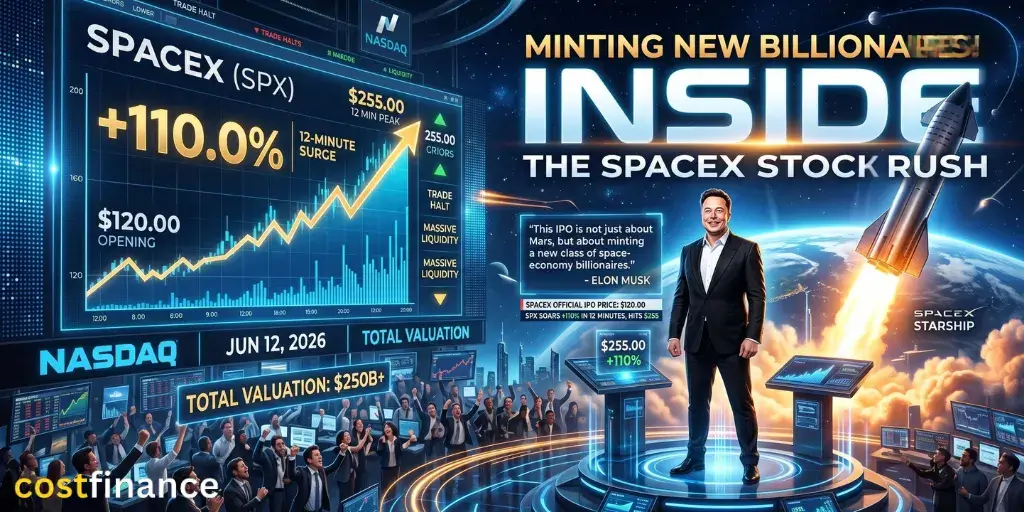
- The Historic Opening: SpaceX officially hit the public markets on June 12, 2026, with an initial listing price of $120 per share, valuing the company at a staggering $250 billion right out of the gate.
- The 12-Minute Surge: Retail and institutional FOMO (Fear Of Missing Out) triggered a massive liquidity rush. Within exactly 12 minutes of the opening bell, the stock skyrocketed by over 110%, halting trading volatility mechanisms as it touched $255 per share.
- Musk’s Declaration: Following the successful launch, Elon Musk addressed the media, stating that this IPO is not just about funding Mars, but about “minting a new class of space-economy billionaires.”
Wall Street has witnessed massive public debuts before, but nothing could have prepared the markets for the sheer gravitational pull of the SpaceX IPO.
On June 12, 2026, the long-awaited spin-off finally materialized, instantly becoming the most significant financial event of the decade. The highly anticipated listing was expected to be explosive, but the actual minute-by-minute price action shattered every modern Wall Street record for a mega-cap tech debut.
Here is the deep dive into the numbers behind the launch, the immediate market fallout, and what Elon Musk’s latest wealth declaration means for the broader space economy.
The Opening Bell: A $120 Launchpad and a 12-Minute Rocket Ride
The underwriters conservatively priced SpaceX’s initial public offering at $120 per share the night before the debut. This price tag already placed the aerospace juggernaut at a massive $250 billion baseline valuation. However, institutional demand severely outweighed the available public float.
When the opening bell rang on the morning of June 12, the order books broke.
Within the first 5 minutes of trading, massive institutional block buys pushed the price past $180. By the 12-minute mark, the retail frenzy fully kicked in, driving the price up to a staggering $255 per share—a massive 112% surge from its initial pricing. The price action was so violent that the exchange was forced to trigger a standard “Limit Up-Limit Down” (LULD) volatility halt to let the market digest the unprecedented volume.
“Minting New Billionaires”: Elon Musk’s Bold Statement
The financial success of the IPO immediately pushed Elon Musk further into an entirely unprecedented stratosphere of personal wealth, cementing his path toward becoming the world’s first legitimate trillionaire. But Musk’s post-IPO address focused entirely on his workforce and the broader economic shift.
Speaking to financial networks shortly after the stock stabilized, Musk made a definitive declaration: “We are not just opening the door to Mars today. By taking this step, we are officially minting a new class of space-economy billionaires. The early engineers, the visionaries who slept on factory floors… they are the new titans of industry.”
Because SpaceX has historically compensated its early engineers and senior staff with aggressive equity packages, the $255 surge instantly converted hundreds of early employees into multi-millionaires, and several top executives into freshly minted billionaires overnight.
The Macro Impact: Sucking the Oxygen Out of the Room
As CostFinance previously highlighted in our deep dives, a catalyst of this magnitude creates massive ripple effects across the sector.
The SpaceX IPO essentially created a capital vacuum on Wall Street. To free up the liquidity needed to buy SpaceX shares, institutional hedge funds aggressively sold off portions of their mega-cap tech holdings (including slight trims in legacy AI giants).
Furthermore, the “halo effect” we predicted for secondary space stocks played out perfectly. While all eyes were on SpaceX, smaller competitors like Rocket Lab (RKLB) and AST SpaceMobile (ASTS) experienced massive sympathy rallies as capital that was priced out of the SpaceX IPO desperately sought cheaper exposure to the space sector.
The CostFinance Verdict
The June 12 SpaceX IPO was not just a stock listing; it was a macroeconomic regime change. The 12-minute surge from $120 to $255 proves that the market is willing to pay an astronomical premium for absolute monopoly power in the commercial space sector.
However, investors looking to enter the stock now must exercise extreme caution. Initial IPO surges are notoriously volatile, and the current $250+ price level prices in decades of flawless execution. If you missed the initial 12-minute rocket ride, the smartest play is to wait for the inevitable lock-up expiration periods and post-IPO volatility to settle before initiating a long-term position.